


In early 2026, a special type of customer sat in front of the mirror in the hair salon. They didn’t bring magazine clippings, nor did they specifically request a celebrity’s style; instead, they sat down, looked at their proportionally balanced faces in the mirror, and asked a simple question: “Do I suit bangs?”
This question recurred because the oval face shape—the kind where the forehead and cheekbones are similarly wide, with a soft jawline—has always been considered the “most versatile” facial contour. But versatility sometimes means too many choices, leading to confusion. Thus, the issue of bangs transformed from a technical matter into a lifestyle choice.
The First Approach: Exploring the Airy Feel
The most common choice recently is a type of bangs so light they’re almost invisible. Unlike traditional blunt bangs that heavily cover the forehead, they’re like a thin veil, casually draped above the eyebrows. Gaps remain between the strands, allowing light to penetrate, wind to blow, and the skin on the forehead to breathe. The popularity of “air bangs” may reflect a certain zeitgeist: people want change but are unwilling to pay too high a price. It doesn’t require a trip to the salon every three weeks; when it grows long, it’s simply swept to the side, blending naturally into the surrounding hair. For those with fast-paced lives who don’t want to be tied down by their hairstyle, it’s a gentle compromise—it has the feel of bangs while retaining the freedom to change it at any time.

The Second Style: Light Behind the Curtains
If air bangs are a tentative step, then “curtain bangs” are a more explicit style statement. Parted in the middle, the hair on both sides frames the face like drawn curtains, drawing attention to the eyes and cheekbones. These bangs are typically the length of the cheekbones or chin, and can be swept back, tucked behind the ears, or left to fall naturally.
Its charm lies in its fluidity. The same person, with bouncy, tousled bangs in the morning, is a lazy Parisian woman; with curled bangs in the evening, she transforms into a sophisticated evening look. For oval faces, curtain bangs have a hidden benefit: they enhance the natural symmetry of the face without making the contours appear too rigid and boring. The asymmetrical fall on both sides creates a touch of imperfect vitality.
The Third Style: The Return of Straight Bangs and Its Conditions
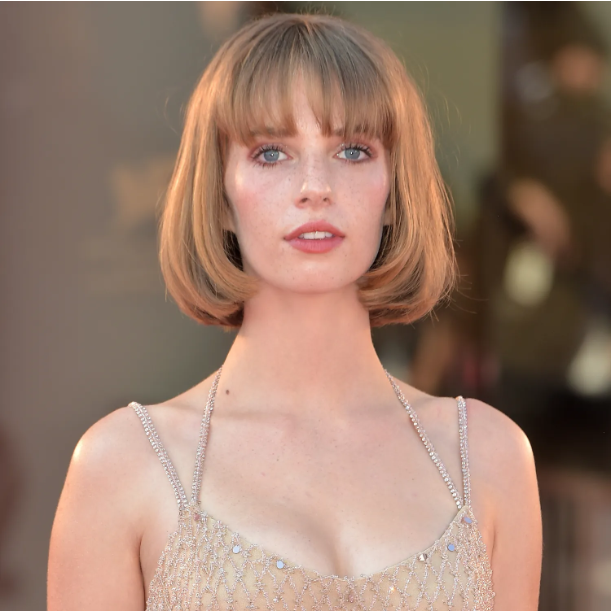
Every few years, straight bangs make a comeback. 2026 is no exception, but this time the return comes with conditions. Hairstylists no longer recommend heavy, straight cuts, but instead favor “layered straight bangs”—the ends are cut with fine layers and the edges have a slight curve, making the bangs look naturally grown rather than artificially sculpted.
This modified version of straight bangs is particularly flattering for oval faces. Because the face is already long enough, traditional straight bangs can sometimes make the proportions appear even narrower and longer; but layered straight bangs, through the choppy ends, create horizontal visual width above the forehead, making the entire face appear more three-dimensional. Of course, this type of bangs requires maintenance—it needs trimming about every three to four weeks to maintain that “just right” length. It’s suitable for those willing to invest time in their hairstyle, and for those who treat going to the hair salon as a ritual.

The Fourth Style: The Wandering Side Part
There’s another type of bangs, one that doesn’t even want to be called bangs. It starts from one side of the hairline, diagonally across the forehead, its length just touching the cheekbone on the opposite side. This “side-parted bangs,” or “slanted bangs,” appeared in 2026 in a looser style—no need for hairspray to hold it at a certain angle; instead, it sways naturally with the movement of the head.
Its advantage is virtually zero maintenance. When you wake up in the morning, it might be to the left or to the right, without affecting the overall look. For those tired of symmetrical aesthetics, side-parted bangs offer an irregular playfulness. The symmetrical contours of an oval face can just handle this asymmetry without appearing unbalanced.
The Fifth Stance: Bangs Without Bangs
Finally, there’s the option of not choosing. In 2026, the hair industry introduced “clip-on bangs”—a section of hair indistinguishable from real hair, secured to the hairline with a few invisible clips, creating the effect of bangs in seconds. When you get home at night, remove it, and you have a clean forehead again.
The existence of this product illustrates modern people’s hesitation about “commitment.” We want to try different looks, yet we don’t want to be defined by any one look. The versatility of an oval face becomes a metaphor here: because everything suits you, you don’t have to insist on anything. Clip-on bangs make this nomadic aesthetic possible—bangs today, no bangs tomorrow, a different length the day after. The face in the mirror is always the same, but the scenery on your forehead is constantly changing.
Bangs as a Lifestyle
In 2026, the discussion about oval faces and bangs had long transcended the technical level. Hairstylists are no longer simply recommending bangs based on face shape; they’re starting to ask about clients’ lifestyles: How much time do you spend styling your hair in the morning? How often do you visit the salon? Do you prefer to be defined by your hairstyle, or have your hairstyle serve you?
The answers to these questions determine the fate of that wisp of hair on your forehead. Airy bangs suit busy people, curtain bangs suit fickle people, straight bangs suit those willing to commit, side-swept bangs suit casual people, and clip-on bangs suit those unwilling to commit. The “versatility” of an oval face isn’t a limitation here, but a freedom—because the contours are already good enough, the choice of style can be entirely determined by lifestyle.
Ultimately, bangs are less a hairstyle and more a way of relating to yourself. They cover your eyes every day, reminding you: the way you see the world can be different every day.